顯示具有 壓瘡定性評估方法 標籤的文章。 顯示所有文章

2016年5月14日 星期六

壓瘡定性評估方法。NPUAP 2016年版壓傷分期

傷口大師 游朝慶 醫師

  在2016年4月8-9日的一場超過400位專家出席的共識會上(NPUAP 2016 Staging Consensus Conference,如圖1) (注:NPUAP,美國國家壓瘡諮詢委員會,National Pressure Ulcer Advisory Panel ),大家對於壓瘡的分期及定義這議題交互討論,以及對於爭議部分予以表決,在這會議中,與會者都使用照片來確認每一個新的術語( terminology)。最後NPUAP在4月13日向世界公布這新的壓傷(pressure injury)語言以及其修正後的分期。同時作為美國健保給付依據的OASIS (Outcome and Assessment Information Set,居家照護評估表)也將同步做修正。

clip_image002

圖1. NPUAP 2016 Staging Consensus Conference

  壓傷的分期是用來表示組織受傷的程度。之前臨床工作者嘗試去診斷及確認壓傷的期別所會遇到的問題都在這次被NPUAP修正。

"Pressure injuries are staged to indicate the extent of tissue damage. The stages were revised based on questions received by NPUAP from clinicians attempting to diagnose and identify the stage of pressure injuries. 

NPUAP Staging Task Force News Release 2016.4.13

   NPUAP並且免費提供13個圖示(圖2-1 - 2-13)來表示各期別(http://www.npuap.org/resources/educational-and-clinical-resources/pressure-injury-staging-illustrations/).


第1期壓傷: 完整的皮膚上有紅斑,給予指壓時不會消失

Stage 1 Pressure Injury: Non-blanchable erythema of intact skin

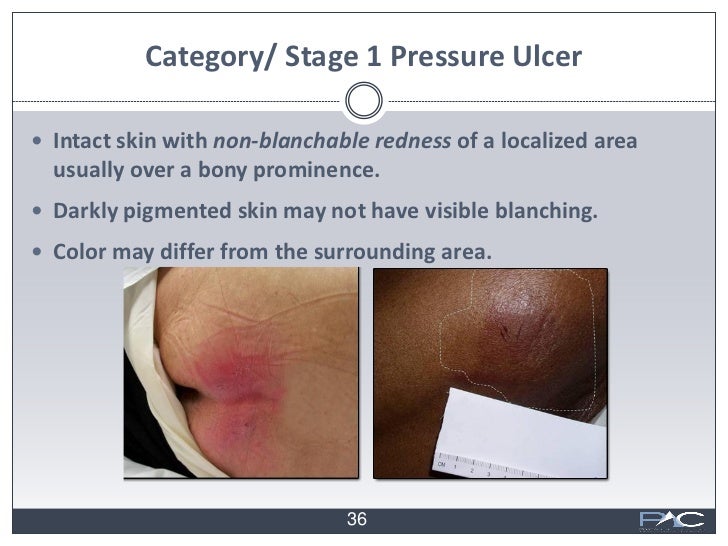
   在完整的皮膚上看到局部有指壓時不會消失的紅斑(如圖2-4, 圖2-6),但這在皮膚較黑的患者上可能會看不到變化(如圖2-5、圖3),雖然如此,可消失的紅斑、感覺異常、體溫異常及皮膚變得較硬都可能會緊接著出現不會消失的紅斑。然而皮膚顏色的變化並不包括紫色或栗色(maroon)(補充:也就是如瘀青般的顏色),其代表著深層組織傷害(deep tissue injury)。
Intact skin with a localized area of non-blanchable erythema, which may appear differently in darkly pigmented skin. Presence of blanchable erythema or changes in sensation, temperature, or firmness may precede visual changes. Color changes do not include purple or maroon discoloration; these may indicate deep tissue pressure injury.

clip_image004

圖2-1. Healthy skin – Caucasian(健康的皮膚–白種人,高加索人)

clip_image006

圖2-2.Healthy skin – Non-Caucasian(健康的皮膚–有色人種)

clip_image008

圖2-3.Stage 1 Pressure Injury – Caucasian(第1期壓傷–白種人,高加索人)

clip_image010

圖2-4.Stage 1 Pressure Injury – Edema(第1期壓傷–水腫),補充:這圖和上一張圖(圖2-3),我看不出差異性,水腫不是壓傷的症狀,但若患者因營養不良導致水腫、或者因失禁導致皮膚潮濕,則比較容易造成第1至第2期壓傷。

clip_image012

圖2-5.Stage 1 Pressure Injury - Non-Caucasian(第1期壓傷––有色人種)

clip_image014

圖2-6.Blanchable vs Non-Blanchable,給予指壓時會消失的紅斑vs不會消失的紅斑

clip_image016

圖3.如右圖,皮膚較黑的人可能無法判斷有無blanchable,圖片取自David Rokes, Debra Kurtz, WoundRounds: Clinical Reimbursement and Wound Care webinar slides, Health & Medicine, Economy & Finance, Business, Nov 11, 2011 http://image.slidesharecdn.com/woundroundsclinicalreimbursementandwoundcarewebinarslides-111111125701-phpapp02/95/woundrounds-clinical-reimbursement-and-wound-care-webinar-slides-36-728.jpg?cb=1321016386

2016年5月6日 星期五

『壓瘡』已被重新命名為『壓傷』

游朝慶 醫師

   The term “pressure injury” replaces “pressure ulcer” in the NPUAP Pressure Injury Staging System

   就在上個月,4/13/2016,美國國家壓瘡諮詢委員會(NPUAP)宣布將常用的『壓瘡pressure ulcer』這個字改名為『壓傷pressure injury』,因為有些壓瘡如第一度壓瘡及深層組織傷害deep tissue injury其皮膚是完整的。

   此外在這個會議中也決議使用阿拉伯數字來命名第1-4期,而不再使用羅馬數字的第I-IV期。並且也把『疑深層組織傷害』的『疑』字拿掉,表示我們可以有信心地正確診斷為『深層組織傷害』。最後這會議也正式承認兩種因醫療器材導致的傷害,也為壓傷的一種,雖然其不符合「在骨頭突出處」這舊定義,第一種傷害為Medical Device Related Pressure Injury:醫療器材導致的壓傷,如Bi-PAP的氧氣罩導致嘴巴鼻子周圍產生壓傷,這類傷口可以使用NPUAP的分期系統來分期,第二種傷害為Mucosal Membrane Pressure Injury:黏膜壓傷,如氣管內管導致口腔的潰瘍,鼻胃管導致的傷口,其無法再被分期。

   詳見 http://www.npuap.org/resources/educational-and-clinical-resources/npuap-pressure-injury-stages/

而且2016年的『壓傷』也被NPUAP重新定義為

    皮膚或皮膚下面的軟組織受損,其通常位於身體骨頭突出處或與某些醫療器材有關。這些傷害看起來可能皮膚是完整的,或有傷口的或者也許會疼痛。導致傷害的原因為強烈的或持續的受壓、或伴隨著剪力,而這些或許也和微氣候、營養、血循、合併症、及軟組織的狀況有關。

A pressure injury is localized damage to the skin and/or underlying soft tissue usually over a bony prominence or related to a medical or other device. The injury can present as intact skin or an open ulcer and may be painful. The injury occurs as a result of intense and/or prolonged pressure or pressure in combination with shear. The tolerance of soft tissue for pressure and shear may also be affected by microclimate, nutrition, perfusion, co-morbidities and condition of the soft tissue.

    相對於壓瘡2007年NPUAP定義(較簡單)

壓瘡是身體骨頭突出處,因為受到重壓,剪力或摩擦,而導致的皮膚或皮膚下面的脂肪或肌肉組織受損,有很多因素會為導致壓瘡,但這些因素的重要性仍然不明。


參考資料來源:

National Pressure Ulcer Advisory Panel (NPUAP) announces a change in terminology from pressure ulcer to pressure injury and updates the stages of pressure injury http://www.npuap.org/national-pressure-ulcer-advisory-panel-npuap-announces-a-change-in-terminology-from-pressure-ulcer-to-pressure-injury-and-updates-the-stages-of-pressure-injury/

2010年3月31日 星期三

壓瘡定性評估方法。顏色分類Color Classification

2010/3/31
衛生署豐原醫院 外科
游朝慶
  • 傷口癒合過程可以被分類為四種顏色
  • 以臨床照顧而言,以顏色分為四期,黑色及黃色為清創感染期,紅色為養肉期,白(粉紅)色為養皮期
  • Cuzzell JZ, The new RYB color code. American Journal of Nursing, 10, 1342-1346.
  • 最早沒有分白(粉紅)色,稱為RYB分類系統
    雖然上面列出了好幾種分類方法,然而這些都需要經過訓練或者曾經經驗,然而在現今,許多傷口都在家照顧,或透過遠距諮詢,因此這種簡單的顏色分類方法RYB system就在1988年由Marion Laboratories藥廠(現在的Marion Merrell Dow)由歐洲引進美國,並由Janice Z. Cuzzell在American Journal of Nursing發表出來,稱為Cuzzell的顏色評估。使用方法為,50% red,25% black,25% yellow,Hellgren and Vincent於1993年又補充一個顏色pink,用來代表上皮化的時期,但這個顏色臨床上都習慣稱呼為白色,較好記(福井の分類:黑、黃、赤、白)。由於這種顏色分類很簡單易懂,也可使用在任何慢性傷口及次級癒合傷口,雖然仍然需要其它的描述補充,如大小,深度,滲液,這方法仍是世界上使用最普遍的方法之一。
-Red: granulation tissue (pink), not all red wounds are healthy....
-Yellow: yellow necrosis, fibrin, exudate, or slough, (whitish yellow, creamy yellow, yellowish green, beige)...
-Black: eschar (necrotic tissue)....
-Pink: proposed by Hellgren and Vincent to classify the wounds at the re-epithelialization stage.
-Other:Arnqvist et al. added another class that contained the undesired reflections in the glossy parts of the wound, which are almost entirely white in the image....

黑色Black
  • 黑痂皮在傷口表面,皮膚及皮下組織皆為壞死

黃色Yellow
  • 黃色壞死組織,不良的肉芽組織,在痂皮去除後會有膿瘍出現
  • 感染的危險性主要由於大量的滲出液
紅色Red
  • 壞死組織及不良的肉芽組織已被去除,留下好的肉芽組織
白色White
  • 在肉芽組織填滿傷口凹陷後,上皮化就在傷口周圍開始
  • 這表皮和周圍皮膚比起來是相對較白的

參考資料
1. Cuzzell JZ. The new RYB color code: next time you assess an open wound, remember to protect red, cleanse yellow, and debride black. Am J Nurs. 1988:88(10):1342–1346.
2. Krasner D. Wound care: how to use the red-yellow-black system. Am J Nurs. 1995:95(5):44–47.
3. Hellgren L, Vincent J (1993) Evaluation techniques for the assessment of wound healing . In: Westerhof W(ed). Leg ulcers: diagnosis and treatment.Elservier Science publishers, pp381-4
圖取自福井基成:褥創治療マニュアル,照林社,東京,1993

壓瘡定性評估方法。NPUAP 2007年版壓瘡分期

2010/3/31
衛生署豐原醫院 外科
游朝慶
Pressure Ulcer Stage
Stage I第一期
舊定義
  • 和周邊皮膚或對側皮膚比起來,其完整的皮膚上有可觀察到和重壓有關的變化,包括溫度,堅實度,或感覺。其傷口在淺色皮膚上看起來是持續地紅,但在顏色較深的皮膚上,顏色可能看起來是紅,藍或紫色。
新定義
  • 為在完整的皮膚上給予指壓時紅斑不會消失,但是皮膚尚未破損,通常位於骨頭突出處,這是皮膚潰瘍的先前表徵。
  • 在顏色較深的皮膚上可能不容易偵測,若局部顏色和周圍皮膚不一樣時就需注意。
  • 注意:此部位可能摸起來會痛,硬,熱,冰等和周圍皮膚不一樣的感覺,在皮膚顏色較深的患者可註明為可能遭受傷害(at risk)的人。
補充:
  • 此新定義再度強調皮膚是完整的,但看起來有一些改變,如顏色,感覺等
舊定義
[A]n observable, pressure-related alteration of intact skin whose indicators as compared to the adjacent or opposite area on the body may include changes in one or more of the following: skin temperature…, tissue consistency…, and/or sensation….
The ulcer appears as a defined area of persistent redness in lightly pigmented skin, whereas in darker tones, the ulcer may appear with persistent red, blue, or purple hues.
新定義
Intact skin with non-blanchable redness of a localized area usually over a bony prominence. Darkly pigmented skin may not have visible blanching; its color may differ from the surrounding area.


Further description:
The area may be painful, firm, soft, warmer or cooler as compared to adjacent tissue. Stage I may be difficult to detect in individuals with dark skin tones. May indicate “at risk” persons (a heralding sign of risk).


Stage II第二期
舊定義
  • 部份皮膚損傷,傷及表皮或真皮。這種潰瘍是表淺的,外表看起來像擦傷、起水泡、或淺的凹陷。
  • 傷口基部呈潮濕粉紅,會有疼痛感。有時會呈現水泡性傷口。
新定義
  • 表皮完全損失及部份真皮損失,表現為一個表淺開放的潰瘍,傷口底部傷口底部是紅或粉紅的,沒有腐肉,也可以表現為充滿漿液完整沒破,或破掉的水泡
  • 注意:傷口底部是發亮或乾的,沒有腐肉,或瘀傷
  • 此時期不該被用來描述撕裂商,燒傷,尿布疹,浸潤或擦傷
  • *瘀傷有可能是疑深層組織損傷 suspected deep tissue injury
補充:
    『淺的凹陷』會讓許多照顧者輕估三度為二度壓瘡,實際上,表皮只有1mm,而真皮層平均只有2mm深,因此二度壓瘡是非常淺的,一旦傷口看起來有凹陷,往往已經是吃到皮下組織,屬於三度壓瘡,因此新的定義將『淺的凹陷』改為『表淺開放的潰瘍』。新的定義並且強調二度壓瘡不該出現腐肉,以及水泡無論破掉與否都算是二度壓瘡,如有瘀傷,則可能會同時存在深層組織損傷,此定義並且排除一些人為的擦傷,抓傷,尿布疹等皮膚損傷
舊定義
Partial thickness skin loss involving epidermis, dermis, or both. The ulcer is superficial and presents clinically as an abrasion, blister, or shallow crater.
新定義
Partial thickness loss of dermis presenting as a shallow open ulcer with a red/pink wound bed, without slough. May also present as an intact or open/ruptured serum-filled blister.
Further description:
Presents as a shiny or dry shallow ulcer without slough or bruising.* This stage should not be used to describe skin tears, tape burns, perineal dermatitis, maceration or excoriation. *Bruising indicates suspected deep tissue injury.


Stage III第三期
舊定義:
  • 全層皮膚都爛掉,深及皮下組織,甚至到達筋膜但沒有穿透,可看到脂肪組織,但看不到肌肉,骨頭,韌帶。
  • 這種潰瘍臨床上看起來像深的凹陷,可能挖入臨近的皮膚。
新定義:
  • 全層皮膚缺損,可看到皮下脂肪,但肌肉,骨頭,韌帶沒有被暴露出來,會出現腐肉,但不阻礙傷口深度的觀察,可以有口袋或隧道形成
  • 注意:在不同解剖位置,其深度會不一樣。在鼻樑,耳朵,後腦杓,腳踝等處沒有皮下脂肪,其三度壓瘡可以非常淺,在脂肪很多的部位,則可能會很深,骨頭及韌帶是不可被看到或摸到。
補充:
  • 新的定義強調全層皮膚缺損,所以已穿過真皮層,傷及皮下脂肪組織,但筋膜仍是完整,故不會看到肌肉,骨頭,韌帶組織
  • 傷口基部不痛。
舊定義:
Full thickness skin loss involving damage to, or necrosis of, subcutaneous tissue that may extend down to, but not through, underlying fascia. The ulcer presents clinically as a deep crater with or without undermining of adjacent tissue. 5
新定義:
Full thickness skin loss. Subcutaneous fat may be visible but bone, tendon or muscle are not exposed. Slough may be present but does not obscure the depth of tissue loss. May include undermining and tunneling.
Further description:
The depth of a stage III pressure ulcer varies by anatomical location. The bridge of the nose, ear, occiput and malleolus don’t have subcutaneous tissue and stage III ulcers can be shallow. In contrast, areas of significant adiposity can develop extremely deep stage III pressure ulcers. Bone/tendon is not visible or directly palpable.
Stage IV第四期
舊定義:
  • 大範圍的全層皮膚和組織潰爛,組織破壞可能深及肌肉、骨頭、或支持性的結構(例如肌腱或關節囊)。
新定義:
  • 全層皮膚缺損,並暴露出骨頭,韌帶,或肌肉,在傷口床上或可見到腐肉或痂皮,通常會有口袋及隧道
注意:在不同解剖位置,其深度會不一樣。在鼻樑,耳朵,後腦杓,腳踝等處沒有皮下脂肪,其壓瘡可以非常淺,四級壓瘡已吃到肌肉,或其支持組織(如筋膜,韌帶,及關節腔)而可能導致骨髓炎,骨頭及韌帶是可被看到或摸到。
補充:
  • 新的定義強調已看到肌肉,骨頭,韌帶組織,常常可看到口袋及隧道,
  • 他提醒,若四度壓瘡久不癒合,要考慮到是否有骨髓炎。
  • 傷口基部不痛。
舊定義:
Full thickness skin loss with extensive destruction, tissue necrosis, or damage to muscle, bone, or supporting structures (e.g., tendon, joint capsule).
新定義:
Full thickness tissue loss with exposed bone, tendon or muscle. Slough or eschar may be present on some parts of the wound bed. Often include undermining and tunneling.
Further description:
The depth of a stage IV pressure ulcer varies by anatomical location. Bridge of nose, ear, occiput and malleolus do not have subcutaneous tissue and these ulcers can be shallow. Stage IV ulcers can extend into muscle and/or supporting structures (e.g., fascia, tendon or joint capsule) making osteomyelitis possible. Exposed bone/tendon is visible or directly palpable.

疑深層組織損傷 Suspected Deep Tissue Injury:
DTI這個名詞,以前往往被稱為密閉壓瘡closed pressure ulcer,紫色壓瘡purple pressure ulcer,深層組織傷害deep tissue damage,臥姿皮膚炎decubitus dermatitis或被認為是不可分期的unstagable,其往往快速惡化,常在骨頭突出處出現淤青。
舊定義
  • 因為重壓導致的在完整皮膚之下的皮下組織傷害。起初表現為深色淤傷,但儘管有適當的治療,還是往往會惡化為第3或第4期壓瘡。
新定義
  • 由於重壓或剪力導致皮下組織損傷,使得局部的完整皮膚出現紫色或紫褐色的,或出現充血的水泡,這種傷口可能繼發於和周邊相比不一樣的皮膚感覺,如疼痛,堅硬,糊稠(boggy,泥沼般,如摸到滑液囊腫或疝氣囊般的感覺,即皮下有一包水的感覺),鬆軟(mushy,固液相共存,半流質semi-liquid,濃粥狀的,有點像擠出的青春痘般糊糊的,或磨砂洗面乳般的感覺),溫暖或冰冷的
  • 注意:在顏色較深的皮膚上可能不容易偵測,其進展可以是在傷口床上有一薄的水泡,或更進一步發展成薄的痂皮,即使有適當的治療,還是有可能快速地進展侵犯到其他組織
  • 下面一個個案說明了深層組織傷害DTI:有一個人在家裡跌倒並且摔斷他的腿,但直到三天後,他才被鄰居發現,在急診室,護士檢查並紀錄說在其薦骨處有一大片瘀青般的紫斑。這個人隨即接受手術治療骨折,並在術後轉到外科病房。病房護士再度評估及記錄其壓瘡,並擬定翻身時間表,以避免平躺。術後三天,薦骨處出現一大片壞死組織,醫師診斷為壓瘡。這個就是深層組織傷害DTI。發生,雖然這個傷害發生在患者在家的那三天,但直到住院三天後,真正的傷害才顯露出來。這個壓瘡的案發現場不是發生在急診室,開刀房,或病房,而是發生在病患的家裡。
如今有這個DTI新定義是有幫助的。以前當患者發生一個疑似DTI,治療者必須去決定這個壓瘡是第一度的(因為其皮膚是完整的),或是不可分期的。如今這類壓瘡已有一個適當的分類。一旦一個DTI發生,即使有最好的治療(如翻身及氣墊床),傷口也可能會快速惡化。
舊定義
Deep tissue injury (DTI) was initially defined as "A pressure related injury to subcutaneous tissues under intact skin. Initially, these lesions have the appearance of a deep bruise and they may herald the development of subsequent development of a Stage III-IV pressure ulcer even with optimal treatment" (NPUAP, 2001).
新定義
Purple or maroon localized area of discolored intact skin or blood-filled blister due to damage of underlying soft tissue from pressure and/or shear. The area may be preceded by tissue that is painful, firm, mushy, boggy, warmer or cooler as compared to adjacent tissue.
Further description:
Deep tissue injury may be difficult to detect in individuals with dark skin tones. Evolution may include a thin blister over a dark wound bed. The wound may further evolve and become covered by thin eschar. Evolution may be rapid exposing additional layers of tissue even with optimal treatment.


無法分期的unstageable
  • 全層皮膚缺損,並傷口底部被腐肉slough或痂皮eschar覆蓋,導致無法評估。
  • 注意:一旦足夠的腐肉或痂皮被清除,露出傷口的底部,及真正的深度,期別就能被確定
  • 然而請特別注意,在腳跟的穩定痂皮stable eschar(乾的,緊密的,完整的,沒有紅或變動的)可以提供『身體自然的生物屏障』,絕對不可以去清除。NPUAP特別去強調這一點,因為腳跟的循環很差,在跟骨和皮膚之間的皮下組織很少(沒有肉),假如壞死組織被清創了,骨髓炎及其隨後的截肢危險機會是非常高的。此時,此部位應避免再度被重壓,而此處的痂皮應保持乾燥及完整。有很多臨床照顧者使用優碘塗抹來保持痂皮乾燥及消毒。
新定義
Full thickness tissue loss in which the base of the ulcer is covered by slough (yellow, tan, gray, green or brown) and/or eschar (tan, brown or black) in the wound bed.
Further description:Until enough slough and/or eschar is removed to expose the base of the wound, the true depth, and therefore stage, cannot be determined. Stable (dry, adherent, intact without erythema or fluctuance) eschar on the heels serves as "the body's natural (biological) cover" and should not be removed.

壓瘡的分級只是適當的記錄影響組織的深淺
  • 第四級的壓瘡就不能往回到第三、第二或第一級,所以已經癒合的第四級壓瘡,在指標報告時還是屬於第四級。
  • 使用壓瘡分級的方法來說明壓瘡痊癒時,必須是表皮下面的組織都逐層的修復回來才算。臨床研究顯示,第四級的壓瘡癒合時都會比較淺,因為表皮長好時,下面長的都不是原來的肌肉、皮下組織和真皮,而是肉芽組織,其是由內皮細胞、纖維母細胞、膠質、和細胞外間質所構成。所以第四級的壓瘡不能變成第三、第二、或第一級的壓瘡,因為解剖與結構上沒有按照表皮、真皮、皮下組織、肌肉、和骨頭的順序長回來。
  • NPUAP於1995年就強調NPUAP分期系統絕對不能用來形容傷口的癒合進展,此建議至今仍是沒變
參考資料
1. http://www.npuap.org/resources.htm
2. http://www.clinimed.co.uk/wound-care/education/indication-classification/pressure-ulcers.aspx
3. Deep Tissue Injury and the NPUAP Staging Definitions; Jackie Todd, RN (slide)http://www.slideshare.net/savealegsavealife/deep-tissue-injury-and-the-npuap-staging-definitions-jackie-todd-rn
4. NPUAP Position on Reverse Staging of Pressure Ulcers. NPUAP Report 1995;4(2).

壓瘡定性評估方法。NPUAP & AHCPR & International NPUAP-EPUAP

2010/3/31

衛生署豐原醫院 外科

游朝慶

    在1989年,美國國家壓瘡諮詢委員會(NPUAP)第一屆共識會議發展出和前述系統相似的一套四期系統。NPUAP Staging System在過去20年來,一直被廣為使用,其stage I 定義為給予指壓時紅斑不會消失(non-blanchable erythema),是皮膚潰瘍的前兆,Stage IV定義為全層皮膚缺損並組織壞死侵及肌肉,骨頭。韌帶,關節等,底部沖刷侵襲(undermining,即pocket口袋),瘻管(sinus tract)也許會伴隨發生。此Stage I的定義因為不好在有深色皮膚的患者上所觀察,於1997年被NPUAP修改為完整皮膚上可被觀察到和重壓有關連的變化,如和周邊或對側的皮膚相比,有溫度(較冷或較熱),組織堅實度(較硬或較鬆軟)或感覺(痛,癢)上的改變。壓瘡在顏色較淡的皮膚上看起來是持續地紅,但在有較深顏色的皮膚上,看起來可能是持續地紅,藍,或紫色。

    NPUAP自1989年來,每兩年開一次共識會議consensus,並討論當時和壓瘡相關重要的議題。當美國健康照顧政策與研究機構the Agency for Health Care Policy and Research (AHCPR)現在的the Agency for Healthcare Research and Quality (AHRQ)),是美國重要的品質推展機構,AHRQ在90年代所發展的19個臨床準則後來已成為實證指引發展的重要模式),打算於1992年推出壓瘡治療準則時,由於在NPUAP很多成員也在AHCPR裡面服務,因此於1991年3月NPUAP針對AHCPR 要發表的壓瘡預防準則pressure ulcer prevention guideline舉辦一場公開辯論,並將此專題藉著AHCPR推廣到全美,在1993年的第3屆大會中,則是討論AHCPR的治療準則『Treatment of Pressure Ulcers』,其在1994年發表(http://www.npuap.org/positn1.htm) 。因此有人將NPUAP的壓瘡傷口分類說是NPUAP(1989)與AHCPR(1994)共同推出來的分類系統。

    NPUAP於1997年第五屆會議時,當時的主題是“Monitoring Pressure Ulcer Healing: An Alternative to Reverse Staging.”並因而推出”PUSH”tool來定量評估壓瘡。在2005年主題為“Merging Missions,”的共識會議上正式討論Deep Tissue Injury (DTI)的病理機轉,並將DTI列進當前的分期系統中的一期(http://www.npuap.org/PDF/Spring_Newsletter.pdf

    歐洲壓瘡諮詢委員會,European Pressure Ulcer Advisory Panel (EPUAP) 也於1999年對於壓瘡發展出另一套四期系統(是grade分級而非NPUAP的stage分期系統),其Grade 1的定義為給予完整皮膚指壓時紅斑不會消失,在有深色皮膚的人,其皮膚的變化可能是變色、熱、腫、或有硬結,Grade 4表示廣泛地破壞,組織壞死,或侵及肌肉、骨頭或其周邊組織,可不伴隨整層皮膚缺損。

    2007年2月,美國NPUAP重新定義壓瘡及其分期,包括原有的四個分期再加上兩個期別,深層組織損傷(deep tissue injury,DTI)及不可分期的(unstageable)。自從DTI於2001年被確認出來之後,經過五年的時間才完成新的分期工作。雖然早在1975年,Shea已定義這個期別,並命名為『許多解剖組織缺損』the amount of anatomical tissue loss,這原始的定義是如此令醫師混淆,並導致無法區分會陰旁皮膚炎(即尿布疹)與DTI導致的潰瘍,而產生不正確的分期。

壓瘡2007年NPUAP定義

    壓瘡是身體骨頭突出處,因為受到重壓,剪力或摩擦,而導致的皮膚或皮膚下面的脂肪或肌肉組織受損,有很多因素會為導致壓瘡,但這些因素的重要性仍然不明。

    目前EPUAP與NPUAP已相互認同彼此的分類,並於2009年共同發表International NPUAP-EPUAP Pressure Ulcer Definition及International Pressure Ulcer Classification System(以下取自於http://www.epuap.org/

International NPUAP-EPUAP Pressure Ulcer Definition國際壓瘡定義

A pressure ulcer is localized injury to the skin and/or underlying tissue usually over a bony prominence, as a result of pressure, or pressure in combination with shear. A number of contributing or confounding factors are also associated with pressure ulcers; the significance of these factors is yet to be elucidated. 此定義和NPUAP 2007年版差不多,只是拿掉摩擦。

International Pressure Ulcer Classification System國際壓瘡分類系統

     過去好幾年來歐洲的EPUAP及美國的NPUAP的成員已經互相討論好幾次關於EPUAP和 NPUAP的pressure ulcer grading/staging systems,由於需要制訂一個全世界共通用的治療與預防準則,故需要一個共通的分類系統,Staging/ grading I到IV代表著壓瘡的進展,但有些人不認同這個詞(stage, grade),我們嘗試去找其他的字來代替,但失敗了,”Category”這個中性字被有些人建議來用,Category(種類)代表著非依等級區別的類別,這讓我們不至於誤用說壓瘡從IV進步到I。然而我們瞭解到,大家早已習慣說―stage‖ 及 ―grade ‖,因此我們提議不管用那個名詞(如stage, grade, 或category)都是可接受以及容易瞭解的,無論如何,此次美歐合作最重要利益在於確認兩者之間對於期別的定義是相同的即使他們被寫為-stage II -grade II-category II,我們都同意壓瘡的四個分期,然而在歐洲無法分期的unclassified/unstageable及深層組織損傷deep tissue injury都被歸類為graded IV,NPUAP同意在準則中將這兩類獨立出來,這個將在比較各國的資料後,在拿來討論。

    下面先列出國際壓瘡分類系統針對美國的壓瘡分類補充的原文,看起來和2007年的NPUAP分類差不多,故在下一節一起解釋。

Additional Categories for the USA

Category/Stage I: Non-blanchable erythema

Intact skin with non-blanchable redness of a localized area usually over a bony prominence. . Darkly pigmented skin may not have visible blanching; its color may differ from the surrounding area. The area may be painful, firm, soft, warmer or cooler as compared to adjacent tissue. Category I may be difficult to detect in individuals with dark skin tones. May indicate “at risk” persons.

Category/Stage II: Partial thickness

Partial thickness loss of dermis presenting as a shallow open ulcer with a red pink wound bed, without slough. May also present as an intact or open/ruptured serum-filled or sero-sanginous filled blister.Presents as a shiny or dry shallow ulcer without slough or bruising*. This category should not be used to describe skin tears, tape burns, incontinence associated dermatitis, maceration or excoriation.

*Bruising indicates deep tissue injury.

CategoryStage III: Full thickness skin loss

Full thickness tissue loss. Subcutaneous fat may be visible but bone, tendon or muscle are not exposed. Slough may be present but does not obscure the depth of tissue loss. May include undermining and tunneling. The depth of a Category/Stage III pressure ulcer varies by anatomical location. The bridge of the nose, ear, occiput and malleolus do not have (adipose) subcutaneous tissue and Category/Stage III ulcers can be shallow. In contrast, areas of significant adiposity can develop extremely deep Category/Stage III pressure ulcers.

Bone/tendon is not visible or directly palpable.

Category/Stage IV: Full thickness tissue loss

Full thickness tissue loss with exposed bone, tendon or muscle. Slough or eschar may be present. Often includes undermining and tunneling. The depth of a Category/Stage IV pressure ulcer varies by anatomical location. The bridge of the nose, ear, occiput and malleolus do not have (adipose) subcutaneous tissue and these ulcers can be shallow. Category/Stage IV ulcers can extend into muscle and/or supporting structures (e.g., fascia, tendon or joint capsule) making osteomyelitis or osteitis likely to occur. Exposed bone/muscle is visible or directly palpable.

Additional Categories/Stages for the USA

Unstageable/ Unclassified: Full thickness skin or tissue loss – depth unknown

Full thickness tissue loss in which actual depth of the ulcer is completely obscured by slough (yellow, tan, gray, green or brown) and/or eschar (tan, brown or black) in the wound bed. Until enough slough and/or eschar are removed to expose the base of the wound, the true depth cannot be determined; but it will be either a Category/Stage III or IV. Stable (dry, adherent, intact without erythema or fluctuance) eschar on the heels serves as “the body’s natural (biological) cover” and should not be removed.

Suspected Deep Tissue Injury – depth unknown

Purple or maroon localized area of discolored intact skin or blood-filled blister due to damage of underlying soft tissue from pressure and/or shear. The area may be preceded by tissue that is painful, firm, mushy, boggy, warmer or cooler as compared to adjacent tissue. Deep tissue injury may be difficult to detect in individuals with dark skin tones. Evolution may include a thin blister over a dark wound bed. The wound may further evolve and become covered by thin eschar. Evolution may be rapid exposing additional layers of tissue even with optimal treatment.

參考資料

1. Agency for Health Care Policy and Research(AHCPR):Pressure Ulcers in Adults:Prediction & Prevention. Wasington DC:U.S. Department of Health Human Services: AHCPR; 1992.

2. http://www.npuap.org/positn1.htm

3. http://www.npuap.org/PDF/Spring_Newsletter.pdf

4. http://www.epuap.org/

壓瘡定性評估方法。IAET & WOCN & OASIS

2010/3/31

衛生署豐原醫院 外科

游朝慶

    世界腸造口治療師協會,The International Association of Enterostomal Therapists (IAET)於1988年發展了一種廣為使用的四級分期系統,IAET定義stage I 為重壓解除30分鐘後仍未改善的紅斑erythema,而stage IV為深層組織破壞,從皮下組織一直到筋膜,且也或許會傷及肌肉關節或骨頭。傷口床往往是沒有痛覺的。IAET在於1992年改名為傷口造口失禁護理學會,the Wound, Ostomy, Continence Nurses' Society (WOCN),並推出第一版的Clinical Practice Guideline for Prevention and Management of Pressure Ulcers,其和IAET的版本差不多,在2003年時又推出第2版,但在2007年NPUAP最新版本推出後,WOCN馬上發表聲明,認同NPUAP的分類。

OASIS補充說明

由隸屬美國衛生暨社會福利部 (DHHS) 的老人暨貧民服務中心,或翻成美國老人醫療保險與失業貧窮救助服務局(Centers for Medicare & Medicaid Services, CMS,類似台灣的中央健康保險局,前身(2001年改名)為美國衛生照護財務局HCFA(Healthcare Financing Administration),其給付約佔全國醫院醫療支出的3成多,於1983年實施依據疾病診斷相關族群 (DRG) 來制定核付方式)在1997年爲了要平衡醫療預算,醫療保險支付改以疾病嚴重程度、功能狀態及治療需要作為居家照護支付依據,推出結果與評估資訊系統Outcome and Assessment Information. Set,OASIS,又稱為居家照護評估表,是由一組各層級專家,經過多年經驗研究發展出來的照護評估表,並在病患接受居家照護服務期間內(收案、60天追蹤再確認、結案時與患者送住院前後時)蒐集這些特定的資料,並比較兩次評估間的差異性,它的評分標準很特殊,是評估健康狀態的改變,OASIS系統以保險給付作為正當性,要求要申報medicare、medicaid的居家機構一律強制使用並上傳。

OASIS項目分為下列幾大類:

(1) 社會、人口學基本資料: 臨床記錄、病史、居住安排及支持性協助的安排等

(2) 生理及心智狀態: 感官、皮膚狀態、呼吸狀態、排泄狀態、神經、情緒、行為表現等

(3) 各項功能狀態: 日常生活功能 (ADL)、工具性日常生活功能(IADL)、藥物及醫療設備、及復健或特殊治療需求等

(4) 轉介、結案相關資料:緊急照護、住醫院或照護機構之原因、結案及後續服務的需求等。

PPS預付制度 (如DRG的定額給付)

(1)支付期間:60天為一單元,60天後將再重新評估個案,若未達60天之期限,個案去世則要退回部份費用,預付制度係以品質為依據;若在期限內訪視次數未達5次,則另有計算方式。

(2)支付費用:每一個案2,000至4000元美金;平均2,500元美金,與地區及稅制有關。

(3)於第一次訪視評估即訂出支付費用,因此護理人員的評估能力是重要的。

(4)申請流程:評估->照護計畫;可開案之專業人員:護理人員、物理治療師、語言治療師;職能治療師為轉介人員。

OASIS的重要功能之一是,它裡面包含了居家照護預付支付系統 (PPS, 自2001年開始,至2008年將作修訂) 所需的資料 -- 居家照護資源群包含三大層面:(1) 臨床診斷的嚴重度、(2) 功能狀態的依賴程度及(3)復健或醫療服務的使用情形。專用的軟體程式可截取OASIS中的資料,自動轉換費用給付碼以為申報費用的依據。

OASIS的重要功能之二是,它可測量“病患的結果" -- 在兩次或更多之時間點上病人狀態之改變。病患的結果(改變)可以是正向的、負向的或是沒有改變的。而造成此結果的原因可能是照護的差異、或疾病本身的進展或是兩者共同的影響。能“測量病患結果"是進行“Outcome Based Quality Improvement (OBQI)"品質促進方案的基礎。

OASIS的重要功用三是在以病患結果為基礎的品質監測 (outcome based quality monitoring, OBQM)的運用:

(1) OASIS可以提供Case Mix案例組合的報告:機構可對其照顧的病人群的嚴重度及特性能有一參考比較的基準。

(2) OASIS可以提供不利或意外事件(Adverse event)報告:不利及意外事件的發生率可反應出病人嚴重的健康問題或是健康功能衰退的情形。

(3) OASIS 中包含了13種不利或意外事件:包括跌倒、傷口、藥物、血糖變化、尿道感染、壓瘡、日常生活功能衰退、非預期之死亡或結案等。

OASIS的重要功能之四是它在以結果導向之品質促進(OBQI)方案的運用:研究指出,OASIS可以測量41種病患結果。這些指標可以被居家照護所影響,而且會經過31項的影響因素的標準化校正(risk adjustment),能反應出接受居家照護的病人的生活品質。結案時病患結果有三大類: 身體功能或健康狀態進步improvement, 穩定stabilization 及醫療資源的使用(例如急診就診或再住院或護理之家安置)。

自1999年七月起公告有關OASIS之條例,2000年七月及2005年十月修訂,最新版於2008 年一月修訂。

    WOCN為因應OASIS要求,於2000年召開專家會議,制訂Most Problematic Pressure Ulcer Score ,將傷口分為四級,針對完全肉芽組織(Fully Granulating)、早期/部分肉芽組織(Early/Partial Granulation)及無癒合(Non-healing)傷口基底部在臨床應用的限制,配合常見慢性傷口(如壓瘡、下肢潰瘍傷口、外科手術傷口)擬出臨床傷口照護評估指引,讓傷口照顧不再一視同仁,而能論質計酬,不同程度的傷口給付不同,其在2009年才根據最新的NPUAP壓瘡分類做第一次的修訂。新的Status of Most Problematic (Observable) Pressure Ulcer將壓瘡分為5個等級,0分是新的上皮組織形成Newly epithelialized,為傷口完全被上皮組織覆蓋,無滲液,無壞死組織(slough,eschar),無感染現象;1分是完全肉芽組織化Fully granulating,為傷口完全被肉芽組織覆蓋,無死腔,無壞死組織(slough,eschar),無感染現象,傷口是開口的;2分是早期/部分肉芽組織化,≧25%傷口床被肉芽組織覆蓋,<25%被壞死組織(slough,eschar)覆蓋,無感染現象,傷口是開口的;3分是無癒合Not healing,傷口有≧25%被壞死組織(slough,eschar)覆蓋,或有感染現象,或沒有肉芽組織,或傷口周圍有過度角質化,或經過完整的處理仍未改善,最後一級為NA,其為因被eschar,slough覆蓋而不可分期的。

    但筆者認為OASIS的傷口分期不該被當作傷口的正式分期,因為其只是OASIS眾多評分項目的其中一項,需透過美國健保局的電腦來評估與解釋,且WOCN早已於2007年正式承認NPUAP的在壓瘡壓口分類。

參考資料:

1. Shea JD (1975) Pressure ulcers: classification and management. Clin Orthop 112: 89–100

2. Wound, Ostomy and Continence Nurses Society (2003). Clinical Practice Guideline for Prevention and Management of Pressure Ulcers ; no. 2.

3. 吳孟嬪,2007美國西雅圖居家護理機構參訪 研習之旅http://open.nat.gov.tw/OpenFront/report/show_file.jsp?sysId=C09602948&fileNo=001

4. 高靖秋,2008年『美國西雅圖Qualis Health居家護理相關制度』之參訪活動。http://www.nurse.org.tw/userfiles/file/magazines/%E7%AC%AC%E5%85%AD%E5%8D%81%E4%B8%80%E6%9C%9F%E8%AD%B7%E8%A8%8A.pdf

5. http://www.wocn.org/pdfs/About_Us/News/Chapter1.pdf

6. http://www.wocn.org/pdfs/GuidanceOASIS-C.pdf

壓瘡定性評估方法。Yarkony-Kirk

2010/3/31

衛生署豐原醫院 外科

游朝慶

    1990年,Yarkony及Kirk等人有感於15年來Shea classification一直是壓瘡界的評估標準,其它的評估方法則大都被認為不可靠而被遺棄,但Shea的評估方法卻是有一些缺點,如Shea的grade I說要表皮缺損,露出真皮,但Yarkony及Kirk等人認為要去區分表皮和真皮的分界是困難的,再則要區分Shea的Grade3及4要去辨認出深部筋膜deep fascia有無被侵犯,但深部筋膜很難去辨認出來,故Yarkony-Kirk的方法只要簡單地看皮膚有無完整,有無看到皮下脂肪,有無看到肌肉或骨頭,而不需像Shea的方法要去辨認出一些組織結構。另一個Yarkony-Kirk方法的優點是其強調預防,在Grade1看到皮膚有發紅時就要積極地去預防壓瘡進一步惡化。

Appearance of Pressure Site

Additional Finding

Grade

red area (erythema) without ulceration皮膚發紅區


1


present > 30 minutes but < 24 hours持續發紅超過30分鐘,但未超過24小時

1A


present >= 24 hours持續發紅超過24小時

1B

epidermis and/or dermis ulcerated with no subcutaneous fat observed表皮或真皮潰瘍,未牽涉到皮下脂肪


2

subcutaneous fat but no muscle observed潰瘍區深入皮下脂肪,但未傷及肌肉


3

muscle and/or fascia observed; no bone observed潰瘍區深入肌肉層,但未深到骨骼


4

bone observed, but no involvement of joint space傷口牽涉到骨頭但未侵犯關節區


5

involvement of joint space傷口牽涉到關節區


6


    Grade 1-4都和NPUAP的stage 1- IV類似,但 Grade5-6在NPUAP仍是stage IV。

    Yarkony-Kirk系統發表於NPUAP之後,但由於NPUAP的系統趁著國家AHCPR推動標準化活動時,將自己的標準置入性行銷,而讓NPUAP迅速成為全國共通的標準系統,Yarkony-Kirk的分類方法雖然比一開始的NPUAP分類方法還要詳細,但就如微軟與蘋果之爭,誰拿到世界標準,誰主導標準的建立,誰就主導整個市場。

參考資料

Kanj LF, Wilking SVB, et al. Pressure ulcers. J Am Acad Dermatol. 1998; 38: 517-536.

Witkowski JA, Parish LC. Letter to the Editor: Classification of pressure ulcers. Arch Dermatol. 1991; 127: 907-908.

Yarkony GM, Kirk PM, et al. Classification of pressure ulcers. Arch Dermatol. 1990; 126: 1218-1219.

于博芮等 最新傷口護理學 華杏出版社 2007年

壓瘡定性評估方法。Shea

2010/3/31

衛生署豐原醫院 外科

游朝慶

    自從1989,美國國家壓瘡諮詢委員會(National Pres sure Ulcer Advisory Panel (NPUAP))與AHCPR發表壓瘡評估系統以來,此工具已成為全世界最廣為使用的壓瘡評估工具之一(Maklebust & Margolis, 1995),此工具也於2007年2月更新為最新版。

    根據NPUAP, 1989的定義,壓瘡是骨頭突出處,因受到重壓或剪力或摩擦而導致皮膚及其下方組織的局部受損。

    歷史上有許多壓瘡的分期系統被發展出來,最早見於文獻的是1955年由Guttman所發展的,於1975年,Darrell Shea,一位在邁阿密大學的骨外科醫師基於病理學的觀察,及組織傷害的深度,發展出第一套有充分證據支持的壓瘡分期系統,他依據軟組織的傷害來定義每一期,此系統由數字分為四期(grade),I到IV以及一種封閉的壓瘡(closed pressure ulcer,其就如目前所稱呼的深層組織傷害deep tissue injury),Grade I是急性發炎反應,而Grade IV是指傷及筋膜及嚴重的侵蝕undermining。各種分類系統也於1959 被Campbell,於1976被Barton,及在1981,1985被Daniel,Priest和Wheatley三人,及1990被Yarkony-kirk 所發展出來,然而Shea的系統直到1980年代末期都一直是美國最廣為使用的系統。

    實際上,Shea classification一共分為五期:

Examination of the Sore

Grade

acute inflammatory reaction involving all soft tissue layers of the skin with erythema of skin; moist irregular partial thickness ulceration limited to the epidermis exposing the underlying dermis may be present

紅斑及破皮,如NPUAP stage I&II

I

acute inflammatory reaction involving all soft tissue layers with a full thickness skin ulcer involving the dermis; may extend to but not go into the underlying subcutaneous fat

吃到皮下脂肪,如NPUAP stage III

II

ulcer extensively involving the subcutaneous fat with undermining of the skin and limited by deep fascia; often necrotic, infected and foul-smelling; patient may be toxic with systemic symptoms

在fascia上方有潛行性傷口,在NPUAP分類上還是stage III

III

ulcer has penetrated the deep fascia; extensive soft tissue spread, osteomyelitis and/or septic and dislocated joints; patient usually highly toxic

穿過fascia,如NPUAP stage IV

IV

large cavity draining through a relatively small sinus, typically overlying a bony prominence; with/without muscle and bone involvement

口小洞大,如同現在NPUAP 的DTI stage

closed

    有人說,Shea的分類比較偏向臨床,哪一個時期適合用哪一種治療,如下表,而NPUAP的分類比較適合護理人員用在預防壓瘡的發生(褥瘡,Wikipedia)

Grade

Treatment

I

local wound care

II

local wound care

III

surgical debridement

IV

radical surgery

closed

surgery with wide excision

參考資料

http://www.medal.org/visitor/www%5CActive%5Cch21%5Cch21.01%5Cch21.01.08.aspx

Shea JD. Pressure ulcers. Clin Orthopedics Related Research. 1975; 112: 89-100.

壓瘡評估方法

2010/3/31

衛生署豐原醫院 外科

游朝慶

    想要做研究的人,第一步總是要去取得研究對象的評估項目及評估標準,最好有一個全世界共通的定義及標準,如此在和世界另一端的學者討論時,才有一種共通的語言,才能利用期刊發表,或國際會議來讓知識傳播到全世界。

    但在傷口學部分,卻沒有一種評估標準適合用在各種傷口,壓瘡有壓瘡的評估方法,糖尿病足部潰瘍也有其不同的評估方式,在中文的資料中,只有慈濟大學護理學系助理教授羅淑芬於2007年於護理雜誌的綜合評論:『慢性傷口之評估與測量原則』,及台大護理系于博芮老師於2007年出版的「最新傷口護理學」,但其資料現在大多已更新,如2007年2月美國NPUAP的大改版,重新定義壓瘡及其分期,而且只對各個方法加以評論,並未建議該採用哪一種方法,雖然其中有些方法為主流,但有些早已過時。

    以下先以回顧世界歷史的角度來漫談壓瘡評估標準的進展,所有的資料都取自於google搜尋,包括簡體中文,英文及日文的2010年最新資料。首先先說定性的分類方法,壓瘡的定性分類往往是依據組織損傷的程度,底下是常用的分類方法

定性分類

  • Shea classification(1975)
  • Yarkony-Kirk classification(1990)
  • IAET (International Association Enterostomal Therapy, 1988)
  • WOCN Staging (Wound Ostomy and Continence Nurses Society, 1992, 2003)
  • OASIS Most Problematic Pressure Ulcer Score(2000,2009)
  • NPUAP Staging (National Pressure Ulcer Advisory Panel, 1989, 2007)
  • International Pressure Ulcer Classification System (2009)
  • RYB Color Classification(1988)

    但定性分類只能讓我們瞭解當前的傷口是處於何種狀態,如何預防惡化或者如何治療,但就研究者而言,我們需要將觀察的各種項目量化,給予不同的權重,讓同一個傷口在不同時間的進展(progress),以數字量化表現出來,因而就出現了下列幾種壓瘡定量評估方法:

定量分類

  • PUHP (2000年)
  • DESIGN-P(2002年)
  • DESIGN-R(2008年)
  • PUHP(1999年)
  • SWHT(1997年)
  • Sessing Scale (1995年)
  • CODED (2000年)
  • PUSH 3.0(1998年改良)
  • PSST(1992年)
  • BWAT (2001年)
  • PWAT(2000年)

在下面幾個章節,我們會一一來探討各種分類方法

參考資料

羅淑芬(通訊作者)、胡文郁(2007):慢性傷口之評估與測量原則。96年 04月發表於護理雜誌,54(2),62-67。

于博芮等:最新傷口護理學,華杏出版股份有限公司,96年3月一版